Carlsbad Federal Workers: Understanding OWCP Medical Exams
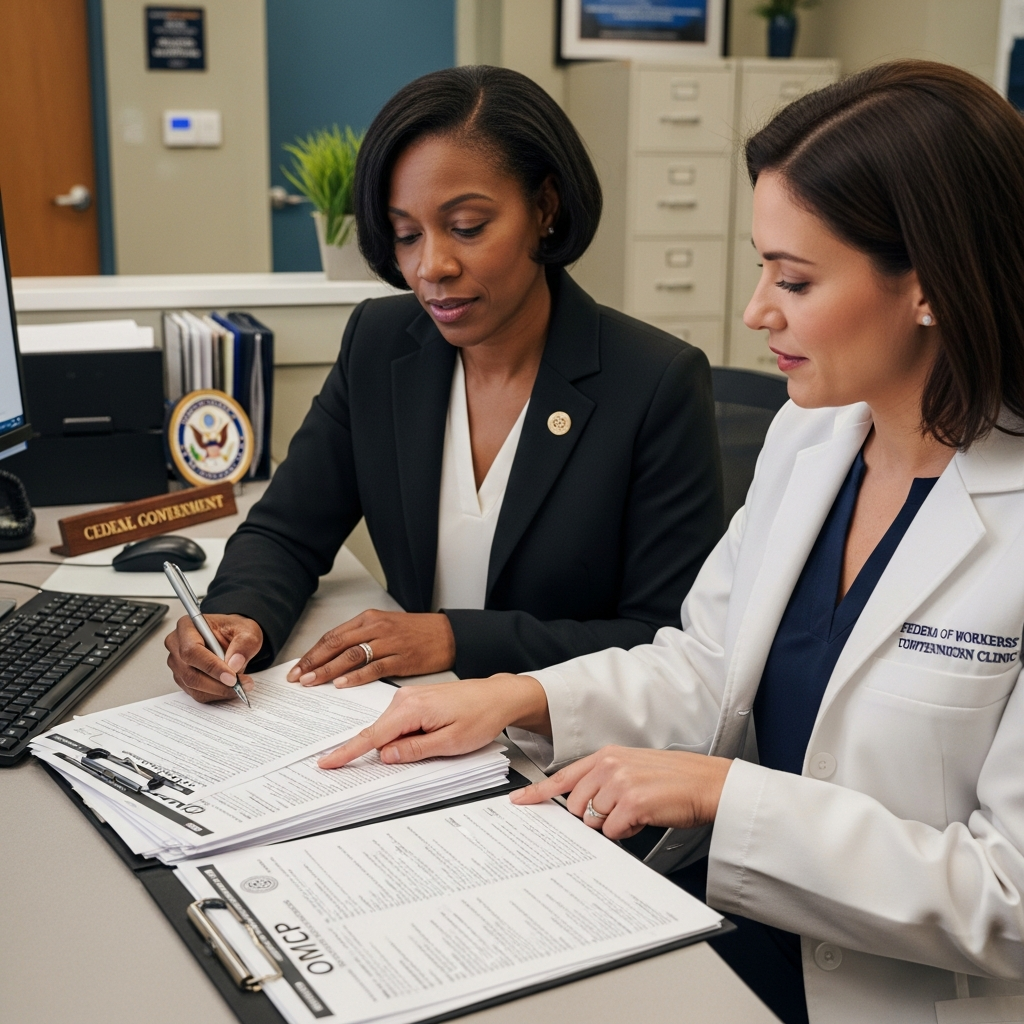
You got the letter. Maybe it was sitting in your mailbox on a Tuesday – just another envelope mixed in with the electric bill and a pizza coupon – but the moment you saw the return address, your stomach dropped. An Independent Medical Examination. Scheduled. Required. Non-negotiable.
If you’re a federal worker in Carlsbad dealing with a work-related injury, you already know that feeling. That mix of anxiety and confusion and maybe a little bit of anger, because you’re still hurting, you’re trying to get better, and now there’s a doctor you’ve never met who’s going to spend maybe twenty minutes with you and somehow have enormous influence over your OWCP claim.
That’s… a lot. And honestly, it’s not fair that so few people explain what’s actually happening.
Here’s the thing about OWCP medical exams that nobody really sits you down and tells you: they’re not the same as seeing your regular doctor. Not even close. When you see your treating physician, that doctor’s entire focus is on helping you heal. They’re on your team. An OWCP exam – whether it’s a Second Opinion Examination or an IME – operates under a completely different set of rules, with a completely different purpose. Understanding that distinction isn’t just helpful. It could genuinely change the outcome of your claim.
And your claim matters. We’re not talking about paperwork here. We’re talking about your ability to pay your mortgage, take care of your family, and get the medical treatment you actually need to recover. Federal workers in Carlsbad – whether you’re working with the postal service, a military installation, a federal agency downtown – you’ve earned those benefits. The OWCP system exists precisely because what happened to you happened *at work*. But the system is complicated, sometimes frustratingly opaque, and there are real stakes involved in navigating it correctly.
So let’s talk about what you’re actually going to find in this article.
You’ll get a clear picture of what OWCP medical exams are and why they’re ordered in the first place – because sometimes understanding the *why* takes away a little of that dread. We’ll walk through the different types of exams you might face, because not every exam is the same and knowing which one you’re dealing with changes how you should approach it.
We’ll also get into the practical stuff. What to bring. What to expect in the room. How to talk to the examiner without accidentally undermining your own case – because yes, that can happen, and it happens more often than people realize. Actually, that’s probably one of the most important things we’ll cover. The things you say (and don’t say) during one of these exams can echo through your claim for months.
There’s also the question of what happens *after* – when the report comes back and maybe it says something you didn’t expect, something that doesn’t match what you’re experiencing every single day. That’s not the end of the road. There are options. There are responses. And we’ll lay those out for you too.
Now, a quick honest note before we get into it: this article isn’t legal advice, and it’s not a substitute for working with a qualified workers’ compensation attorney if your situation is complex. But knowledge is its own kind of protection. The more you understand about how this process works, the less likely you are to feel blindsided – and the better positioned you are to advocate for yourself.
Federal workers in Carlsbad are tough. You show up, you do difficult jobs, and when something goes wrong, you deserve a system that actually works for you. The OWCP process can feel like it’s designed to be confusing, like there’s some secret language everyone else speaks and you’re just supposed to figure it out.
You’re not supposed to figure it out alone.
That’s what this is for. Grab your coffee, give yourself twenty minutes, and let’s actually make sense of this together.
What OWCP Actually Is (And Why It Matters to You)
If you’ve never had to deal with a workplace injury before, OWCP probably sounds like alphabet soup. The Office of Workers’ Compensation Programs is the federal agency that handles workers’ compensation for federal employees – not state workers, not private company employees, but specifically people who work for the federal government. So if you’re a federal worker in Carlsbad, whether you’re at a military installation, a federal agency office, or a postal facility, OWCP is your system.
Think of it this way: when a regular employee at a private company gets hurt at work, their employer’s state workers’ comp program kicks in. Federal workers have their own lane entirely. Different rules, different processes, different… everything, honestly.
The specific program most federal workers use is called the Federal Employees’ Compensation Act – FECA for short. It’s been around since 1916, which is either reassuring (it’s established!) or a little alarming (some of the thinking behind it is old). The program covers medical treatment, wage replacement, and vocational rehabilitation for federal employees who are injured on the job or develop work-related illnesses.
The Role of the Medical Exam in Your Claim
Here’s where things get genuinely confusing for a lot of people, so let’s slow down for a second.
In most aspects of life, your doctor’s opinion is basically the final word on your health. Your physician says you have a herniated disc, you have a herniated disc. With OWCP, it’s… more complicated than that. The medical evidence absolutely matters, but OWCP has its own evaluation process – and that process often includes independent medical exams, also called second opinion exams or referee exams, depending on the situation.
Why does this exist? The honest answer is that there’s a tension built into the system. Your treating physician knows you, cares about your wellbeing, and advocates for your recovery. OWCP, as a program managing billions of dollars in claims, needs to verify that treatment is appropriate, that conditions are genuinely work-related, and that impairments are accurately assessed. Neither side is wrong, exactly. They just have different perspectives. It’s a little like having your best friend vouch for you and then still having to pass a background check.
What “Work-Related” Really Means
This concept trips people up more than almost anything else in the OWCP world. A condition being work-related doesn’t mean it *only* could have happened at work. It means work activities were a significant contributing cause of the condition.
So if you had a pre-existing back problem and a repetitive motion task at your federal job made it substantially worse? That can absolutely qualify. If you developed carpal tunnel syndrome over years of keyboard work? Potentially covered. The medical exam process often revolves around this exact question – establishing or contesting the causal relationship between your work duties and your diagnosed condition.
Actually, this is one of the reasons medical documentation from the very beginning of an injury matters so much. Causation is much easier to establish when there’s a clear, contemporaneous record. Trying to reconstruct that connection months or years later is, well… an uphill climb.
The Different Types of Exams You Might Encounter
Not all OWCP medical exams are the same thing, and mixing them up causes real confusion.
A second opinion exam happens when OWCP wants an independent physician to weigh in on your condition, treatment plan, or work capacity. This is routine – don’t read too much into it if one gets scheduled. A referee exam (sometimes called a referee physician exam) comes into play when your treating doctor and the OWCP second opinion physician disagree. Think of it as a medical tiebreaker.
There are also fitness-for-duty examinations, which your employing agency can require separately from OWCP – these determine whether you’re capable of performing your job duties. People often conflate these with OWCP exams, but they serve different purposes and are governed by different rules.
And then there are impairment rating exams, which assess permanent functional loss and affect long-term benefits. These tend to carry significant financial weight.
Each type of exam has its own purpose, its own standards, and – importantly – its own implications for your claim. Knowing which kind you’re dealing with helps you understand what’s actually at stake. That context isn’t just nice to have. It’s essential.
What to Do Before Your Exam (Don’t Skip This Part)
The week before your OWCP medical exam isn’t the time to wing it. Federal workers in Carlsbad who walk in prepared consistently get better outcomes – and honestly, it’s not that complicated once you know what to actually do.
Start by pulling together every piece of documentation you have related to your injury. We’re talking incident reports, treatment records, pharmacy printouts, physical therapy notes, imaging results… all of it. Organize it chronologically. Your examining physician may only have twenty minutes with you, and they’re working from a file that may or may not be complete. Gaps in that file become gaps in your claim.
Here’s something most people don’t realize: you’re allowed to bring a written summary of your symptoms and how your injury affects your daily work and home life. One page, clear and specific. Not “my back hurts” – more like “I cannot sit for longer than 15 minutes without sharp pain radiating down my left leg, which prevents me from completing my administrative duties at my workstation.” Specificity is everything here.
How to Talk to the Examiner (This Matters More Than You Think)
The doctor conducting your OWCP exam – whether it’s an IME or a second opinion exam – is not necessarily your ally. That’s not cynicism, it’s just the reality of the process. They’re there to evaluate, not treat. So how you communicate directly affects what ends up in the report.
Be honest, but be complete. A lot of workers accidentally undersell their symptoms because they want to seem tough, or they’re having a “good day” and don’t mention that yesterday was awful. Tell the doctor about your worst typical day, not your best one. If your shoulder aches every morning for the first two hours but feels manageable by noon, say that. If you’ve stopped coaching your kid’s soccer team because of your knee, say that too. Functional limitations outside of work absolutely count.
Don’t exaggerate, obviously – that can backfire badly. But don’t minimize either. Both extremes hurt your case.
Actually, one more thing on this… when the examiner asks what you can and can’t do, answer for yourself. Don’t guess what they want to hear. Don’t look for cues in their expression. Just describe your reality plainly.
After the Exam: The Steps Most People Miss
The exam ends and most people just… wait. That’s a mistake.
Within 24 hours, write down everything you remember about the exam. What was asked, what you said, how long it lasted, whether the doctor seemed rushed, whether they actually examined you physically or mostly just reviewed paperwork. This record is invaluable if you need to contest the findings later.
Then follow up with your treating physician. Share what happened at the exam and make sure your regular doctor’s records are current and thorough. If there’s a disconnect between what your treating physician documents and what the IME doctor concludes, having detailed ongoing records from your own doctor gives you real ground to stand on.
You can also request a copy of the final exam report through the OWCP process. Read it carefully. Look for factual errors – wrong dates, misquoted statements, conditions that weren’t mentioned. These aren’t just nitpicks; errors in an IME report can be formally challenged, and sometimes that’s exactly where a claim turns around.
Getting the Right Medical Support in Carlsbad
Here’s where it gets practical for you specifically. The Carlsbad area has providers experienced with federal workers’ compensation cases, and choosing one who understands OWCP documentation requirements makes a real difference. Not every clinic knows how to write notes that actually hold up in the OWCP system – there’s specific language, specific functional assessments, specific forms that move claims forward instead of stalling them.
A medical weight loss clinic that works with injured federal workers, for instance, can address the weight-related complications that often develop after a workplace injury limits your mobility. That’s not a side issue – secondary conditions affect your primary claim, and treating them proactively strengthens your overall medical picture.
The bottom line is this: OWCP exams feel intimidating because the stakes are real. But they’re navigable. Prepare your documentation, communicate clearly and completely, follow up immediately afterward, and stay connected to a treating physician who understands how this system works. You’re not powerless here – you just need to know how to show up.
When the System Feels Like It’s Working Against You
Let’s be honest for a second. The OWCP process was not designed with your comfort in mind. It was designed to be thorough, to protect against fraud, and to manage costs – which sometimes puts you, the injured federal worker, in a pretty frustrating position. Knowing what actually trips people up can save you a lot of heartache.
The “Independent” Medical Exam Isn’t Always What It Sounds Like
Here’s something people don’t tell you upfront: the doctor conducting your Independent Medical Exam, or IME, is often hired by OWCP or your agency. They’re not your doctor. They don’t have an ongoing relationship with you. They’re reviewing your case, not treating you.
This doesn’t mean they’re out to get you – most are genuinely trying to do their job professionally. But it does mean they might reach different conclusions than your treating physician. That gap between what your doctor says and what the IME doctor says? That’s where a lot of claims get complicated.
What actually helps here: Document everything before you go. Bring a written summary of your symptoms, how they affect your daily work and life, and your medical history related to the injury. Don’t assume the examiner has read your full file thoroughly. Sometimes they have fifteen minutes and a thick folder. You filling in the gaps – calmly and factually – matters more than you’d think.
The Timeline Will Test Your Patience
Most people underestimate how slow this process moves. Weeks pass. Then more weeks. You’re waiting on a report, then waiting on a decision, then waiting on an appeal response… it genuinely feels like the bureaucratic equivalent of watching paint dry in a humid room.
The real trap is assuming silence means things are moving along fine. Often, silence means something got lost, a form wasn’t processed, or your claim is sitting in a queue that nobody told you about.
Check in. Follow up. Keep records of every phone call – date, time, who you spoke with, what they said. It feels like overkill until the day it absolutely saves you.
Your Own Medical Records Can Work Against You
This one surprises people. You might have inconsistencies in your records – not because you were dishonest, but because pain fluctuates, appointments are rushed, and doctors document things differently. Maybe one visit you rated your pain a 3/10, and the next you said 7/10. The IME doctor might flag that as inconsistency rather than understanding it as the natural variability of chronic pain or injury recovery.
The solution is straightforward but requires effort: Talk to your treating physician before any OWCP exam. Make sure your records accurately reflect your functional limitations, not just your pain levels. Pain scores are subjective and easy to challenge. Functional limitations – “patient cannot lift more than 15 pounds, cannot sit longer than 30 minutes” – are far more concrete and defensible.
The Examination Day Itself
People get nervous, and nervous people either downplay their symptoms to seem credible or accidentally exaggerate without realizing it. Both create problems.
Don’t perform being okay. If bending a certain way hurts, say so. If you had to rest the day before the exam because you knew it would be taxing, mention that. The examiner is trained to observe how you move in the waiting room, how you get up from a chair, how you carry yourself – not just what you say in the room. Just be consistent and honest throughout.
Actually, that reminds me of something worth saying plainly: wear what you actually wear. Don’t dress up to seem professional if it means hiding a brace you normally use. Don’t push through pain to seem stoic. The exam is a snapshot, and you want that snapshot to be accurate.
When a Claim Gets Denied
It happens. A lot. And it’s demoralizing in a way that’s hard to describe if you haven’t been through it – especially when you know your injury is real and work-related.
Denial isn’t the end. You have the right to request reconsideration, submit additional medical evidence, or appeal to the Employees’ Compensation Appeals Board. The key is responding within the deadlines – missing those windows is what actually closes doors.
Getting a workers’ compensation attorney or a OWCP claims specialist involved at this stage is often worth it. Many work on contingency for federal cases. The paperwork labyrinth at the appeals level is genuinely complex, and having someone who knows the system can make a real difference.
What to Expect After Your Exam
Here’s the honest truth: the OWCP process moves slowly. Like, frustratingly slowly. If you’re expecting a decision within a week or two, I want to gently reset that expectation right now – because going in with realistic expectations is genuinely one of the most helpful things you can do for your own stress levels.
After your medical exam, the physician submits their report directly to OWCP. That report gets reviewed by claims examiners who are, in all likelihood, managing enormous caseloads. A decision can take anywhere from a few weeks to several months depending on the complexity of your case, whether additional documentation gets requested, and honestly – just where your file lands in the queue.
That waiting period is uncomfortable. You’re not imagining that.
The Possible Outcomes (And What They Actually Mean)
When OWCP reviews the medical exam report, a few things can happen. Your claim gets approved, which is obviously the outcome you’re hoping for. But it’s also possible that
– OWCP requests more information – this is actually really common and doesn’t necessarily mean bad news. They might need additional medical records, clarification from your treating physician, or supplemental documentation about the work incident itself. – You receive a schedule for another exam – sometimes a second opinion is ordered, especially in contested or complicated cases. Annoying? Yes. Normal? Also yes. – Your claim gets denied – this feels devastating, but it’s not the end. More on that in a moment.
Don’t read too much into silence during this period. No news genuinely isn’t always bad news – it often just means your file is sitting in a pile waiting for review.
If Your Claim Is Denied
Take a breath. A denial isn’t a final answer.
The OWCP appeals process exists precisely because initial denials happen – sometimes for technical reasons that have nothing to do with the legitimacy of your injury. You have the right to submit additional medical evidence, request reconsideration, or appeal to the Employees’ Compensation Appeals Board (ECAB).
What matters here is acting within the right timeframes and getting proper support. This is where connecting with a workers’ comp attorney or a representative who specifically understands federal employee claims becomes really valuable. The appeals process has its own paperwork, deadlines, and quirks – it’s not something you want to navigate alone while also recovering from an injury.
Keeping Your Own Records Right Now
While you’re waiting, there’s something genuinely productive you can do: build your own paper trail. Keep copies of every document you submit. Note dates and the names of anyone you speak with at OWCP. Continue attending all medical appointments and make sure your treating physician is documenting your condition consistently – gaps in treatment can complicate claims later.
Actually, this is something people often overlook… Your treating physician’s ongoing records matter even after the OWCP exam. Don’t assume the process is “out of your hands” just because the exam is done.
What “Normal” Looks Like Here
For federal workers in Carlsbad and the broader San Diego area, most folks navigating OWCP claims find themselves somewhere in this rough timeline – and I want to emphasize *rough*
– Initial review after exam: 30 to 90 days is common – Response to additional documentation requests: Add another 30 to 60 days – Full claim resolution: Realistically, anywhere from a few months to well over a year for complex cases
I know that sounds like a long time. It is. The system isn’t designed for speed, unfortunately – it’s designed for thoroughness. Whether that trade-off feels fair when you’re dealing with an injury and financial uncertainty is a completely different conversation.
Staying Connected to Support
You don’t have to white-knuckle through this alone. OWCP has a district office that serves California federal employees, and your agency’s human resources department should have a workers’ compensation coordinator who can answer basic procedural questions. If you feel like things have stalled or gone sideways, a federal workers’ comp advocate or attorney can often identify next steps you might not be aware of.
The process is genuinely complicated – there’s no sugarcoating that. But understanding the timeline, knowing that delays are normal, and staying proactive with your own documentation? That puts you in a much stronger position than most people walking into it.
If you’ve made it this far, you probably have more questions than when you started – and honestly? That’s completely normal. Navigating OWCP medical exams as a federal worker in Carlsbad isn’t exactly a straightforward process. There are forms and timelines and second opinions and IMEs… it can feel like you’re trying to solve a puzzle while someone keeps moving the pieces.
Here’s what we want you to hold onto, though: you don’t have to figure this out alone.
The workers’ compensation system was designed to protect you. It doesn’t always feel that way – especially when you’re dealing with a painful injury, time away from work, and paperwork that seems to multiply overnight. But your rights as a federal employee are real, and the medical support available to you is more accessible than most people realize.
Your Health Is Still the Main Thing
It’s easy to get so wrapped up in the administrative side of all this that you lose sight of what actually matters – your recovery. The exams, the documentation, the IME appointments… those are tools. They’re meant to serve your healing process, not the other way around. Don’t let the stress of navigating the system pull your attention away from taking care of yourself. Sleep. Follow your treatment plan. Ask questions at your appointments. That stuff matters more than people give it credit for.
A Good Medical Provider Changes Everything
Working with a clinic that genuinely understands OWCP requirements can be the difference between a smooth claims process and months of unnecessary frustration. Providers who are familiar with federal workers’ comp know what documentation is needed, how to communicate with claims examiners, and – maybe most importantly – how to actually listen to what you’re experiencing. That kind of support isn’t a luxury. It’s something you deserve.
What to Do If You’re Feeling Overwhelmed
Take a breath. Seriously. Then start small – make a list of what you know, what you don’t know, and what your most immediate concern is right now. Is it understanding an upcoming exam? Getting your treatment properly documented? Finding out whether a second opinion makes sense for your situation? Breaking it down like that makes the whole thing feel a lot more manageable.
And if you’re not sure where to start, that’s okay too. That’s what we’re here for.
At our Carlsbad clinic, we work with federal employees dealing with exactly these kinds of situations – and we know how much is riding on getting it right. We’re not here to push you toward anything that doesn’t fit your needs. We just want to help you understand your options and make sure your medical care is working *for* you, not against you.
So if you’ve got questions – whether they’re big picture or surprisingly specific – reach out. No pressure, no commitment. Just a real conversation with people who know this stuff and genuinely want to help. You can give us a call, stop by, or send a message whenever you’re ready. There’s no wrong time to ask for a little guidance.
You’ve been through enough already. Let’s make the road from here a little easier.